The Las Vegas GP exposes energy management and aerodynamic deficit in F1
The race in Nevada highlighted how battery usage dictates positions, with Verstappen winning through strategy. McLaren and Ferrari suffered severe top-speed losses due to their technical designs.
 Formula Readers newsroom · 2 min read
Energy management defines the race
Brazil highlights that Verstappen’s victory relied on preserving energy for the decisive sector, while the UK explains how drivers are blocked in deployment maps. Italy details that Antonelli lost opportunities by lifting off the throttle and deactivating regeneration.
 Why drivers kept changing positions in the spectacular Las Vegas GP
 Featured Comment: How F1’s power units dictated when drivers overtook in Las Vegas | Brief
- Kimi Antonelli reveals cause of Mercedes power glitch at Las Vegas GP
 Antonelli: why lifting off the throttle confused the PU and extinguished victory dreams
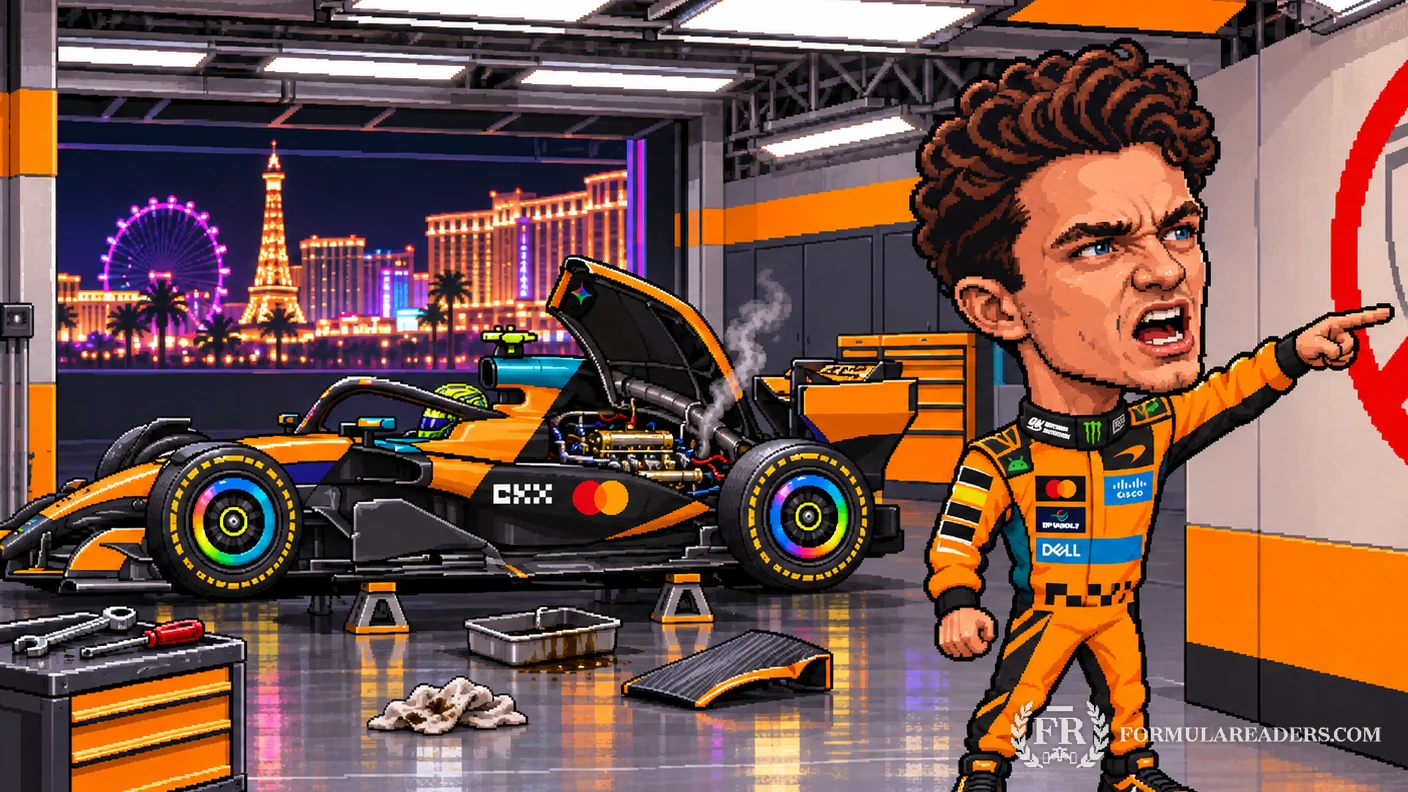
McLaren suffers from lack of top speed
The UK collects Norris’s criticisms of the ‘catastrophic’ performance on straights. Germany and Latin America point out that blame lies with short gear ratios and low aerodynamic efficiency, aggravated by a plastic bag on the car floor.
 McLaren: Piastri surprises due to speed disadvantage in Las Vegas
- McLaren: The speed difference on the straights of Las Vegas surprises Oscar Piastri
 Piastri questions the "strange" pace difference compared to other cars with Mercedes engines in Las Vegas
- McLaren analysed its top-speed deficit in the Las Vegas qualifying session
- McLaren explain Oscar Piastri struggles in Las Vegas qualifying
- McLaren reveal 'unlucky' incident that cost Lando Norris in Las Vegas qualifying
 McLaren explain how a plastic bag derailed surprising Lando Norris attack
- McLaren clarifies: a plastic bag slowed Lando Norris in Las Vegas qualifying
- McLaren: A plastic bag slowed Lando Norris in Las Vegas qualifying
- How McLaren tried to mitigate its Las Vegas F1 top speed deficit
 Norris describes McLaren's straight-line speed in Las Vegas as "catastrophic"
- Norris frustrated by ‘shocking’ deficit costing McLaren dearly
- Lando Norris demands McLaren fix after 'horrendous' handicap exposed
 Norris criticises McLaren's "catastrophic" top speed in Las Vegas
- Stella reveals damage to Norris's car: "He would have been on the front row"
Ferrari and Honda penalised by their engines
Italy and France analyse that Ferrari loses a second on straights due to its exhaust wing and small turbo. Spain and Japan confirm that Honda leaves Alonso without power, losing up to three seconds per lap against rivals.
 Alonso: "The engine gave up. It's broken. We have to change it."
 Honda F1 in Las Vegas: "We are moving in the right direction" despite the lack of power
- Verstappen criticises Ferrari car for its lack of speed in Las Vegas
- Ferrari loses a second on the straights of Las Vegas by keeping the full FTM
- Verstappen explains Ferrari's lack of top speed in Las Vegas
- Verstappen points out that Ferrari penalises itself on the straight due to its aerodynamic options
- Alonso criticises Honda's lack of power in Las Vegas
- Fernando Alonso laments Aston Martin problem after untelevised radio message
- Alonso: Honda's power deficit means rivals take distance behind Aston Martin
- Verstappen identifies Ferrari's exhaust design as cause of its lack of top speed
- Verstappen identifies the exhaust wing as the cause of Ferrari's top speed deficit
- Fernando Alonso: Honda lacks so much power that rivals take extra margin behind us
Tyres and strategy in the cold
The Netherlands and Japan report that Pirelli ruled out the undercut due to difficulty warming tyres at 10°C. Latin America adds that for Qatar, a limit of 27 laps per set will be imposed due to the track’s thermal stress.
- Tyre strategy predictions for the 2026 Las Vegas Grand Prix final
- Pirelli warns that the undercut will not be effective at the 2026 Las Vegas Grand Prix
- Strategies for the Las Vegas Grand Prix
- F1 teams handed undercut warning for the Las Vegas Grand Prix
- Pirelli analysis for Las Vegas GP: Soft compound advantage and one-stop strategy
- 27-lap limit per tyre set in the Qatar Grand Prix
- Vegas 2026: a single pit stop and the undercut proving ineffective
- Pirelli strategies: the cold is a threat, but some know how to manage it
- Strategies for the Las Vegas Grand Prix: one pit stop and the challenge of the cold
- Pirelli’s F1 tyres still can’t cope with Losail: Maximum stint lengths imposed again | Formula 1
- Major limits announced for F1 Qatar Grand Prix over safety concerns
Verstappen with technical issue without solution
The UK and Japan reveal that Verstappen has been dragging a steering or RB22 feel issue since Brazil. The driver admits the team knows the cause but cannot repair it for the remaining races.
- Max Verstappen reveals enlightening insight into 'weird' Red Bull issues
- Max Verstappen remains tight-lipped over growing Red Bull problem
- Verstappen reveals an unsolvable problem with his Red Bull for Las Vegas
- Verstappen suffers 'secret problem' in the RB22 that he cannot fix for now
- Max Verstappen reveals mysterious Red Bull issue that cannot be fixed in Las Vegas
- Verstappen reveals mysterious Red Bull F1 car issue that cannot be fixed in Las Vegas
Cadillac confirms V8 engines for 2030
Argentina and Latin America detail that GM confirmed the development of its own V8 turbo power units from 2030. France explains that this decision aims to simplify the technology and recover commercial interest.

Previous story: Ferrari and McLaren lose on straights; Verstappen suffers mysterious failure at Red Bull