Honda no fault with Alonso, Pirelli limits tyres and V8 for 2030
Honda finds no anomalies in Alonso's engine despite his complaint. Pirelli imposes a limit of 27 laps per set in Qatar. F1 confirms the return of V8 turbo engines for the 2030 season.
 Formula Readers newsroom · 3 min read
Honda denies fault in Alonso's engine
Honda reviewed data and physically inspected Fernando Alonso's power unit after his retirement in Las Vegas, finding no anomalies. The Japanese manufacturer admits that current performance does not generate full confidence in the drivers, which could explain the sensation of a breakdown. Further tests will be maintained during the Qatar practice sessions.
 Honda does not rule out a phantom engine fault in Alonso's car
- Orihara, track boss at Honda: "This year the engine performance is not enough to give confidence to the driver"
 Honda denies engine failure in Alonso's car after retirement in Las Vegas
 Honda can't find Alonso's 'broken' engine issue - again
- Honda cannot find the issue Alonso felt in Las Vegas, but acknowledges a key weakness
- Honda denies issues with Fernando Alonso's engine in Las Vegas
 Honda found no issues with Alonso's engine after his retirement in Las Vegas
 Honda deny problem with Fernando Alonso engine after mysterious issue
- Honda in race against time as shock F1 engine plan revealed
- From the cold of Las Vegas to the heat of Qatar: Honda forced to adjust its engine
 Honda redesigns battery for 2027
 Aston Martin: the AMR26 competes with Mercedes in corners, but loses 3s on straights with the Honda engine
Pirelli limits tyres to 27 laps in Qatar
Pirelli and the FIA established a maximum limit of 27 laps per set of tyres for the Qatar Grand Prix, forcing at least two pit stops. The measure responds to the high lateral and thermal loads of the Lusail circuit, especially on the front left tyre. The harder compounds (C1, C2, C3) will be used to manage wear.
 Qatar GP 2026: why Pirelli only allows 27 laps in Qatar
- Pirelli defines tyres for Qatar and limits to 27 laps per set
- F1 | Megaride Simulation: At Lusail, managing the high thermo-mechanical stress on tyres is essential
 McLaren flags the crucial early-stop trap inside Qatar’s raised 27-lap rule
- McLaren prepares to take specific risks in the Qatar Grand Prix
- F1 drivers face highest tyre pressure orders yet in Qatar
- What impact will tyre-limit rule have on Qatar GP?
- Why the Qatar GP is home to a unique and unusual F1 rule
- Racing Bulls confident in its F1 ahead of the Qatar Grand Prix
- Tyre usage limit defines strategies in the Qatar Grand Prix
- Key strategic points for the Qatar GP: Pirelli warns about graining
- Qatar GP: attention to graining. At least 2 stops per car
Confirmation of V8 engines for 2030
F1 and the FIA agreed to introduce 2.1-litre V8 turbo engines in 2030, advancing the change from the current V6 hybrids by one year. This decision aims to reduce costs and technical complexity, decreasing the proportion of electric power to prioritise the thermal engine and sustainable fuels. The development of current engines is being considered for freezing from 2028 onwards.
- Las Vegas: Is it just a battery issue? Technical analysis and the future of F1
- Ferrari: from the worst to the best track
- The return of V8 engines to F1 in 2030 is much more than just noise: why?
- F1 considers freezing engines amid Cadillac advantage
- F1 could freeze engines in 2028 to prevent GM advantage
- F1 2030: V8 hybrid with a lower electric proportion and closer ties to road cars
- The consequences of the premature switch to V8 engines in F1
- A lesson in F1's looming overtaking issue 🔀
- Zak Brown rules out McLaren engine programme for F1 2030
- V8 and new rules: what changes in 2030 with F1 engines
- Formula 1 could freeze engines in 2028 due to Cadillac's strategy
Hadjar explains wing breakage in Las Vegas
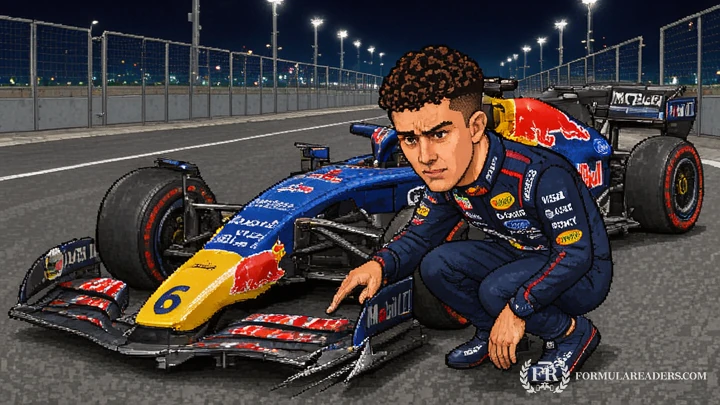
Isack Hadjar attributed the breakage of his front wing to a coincidence between the closing of the active aerodynamics system and a bump on the track. Red Bull has reinforced the part to prevent recurrences, although the incident cost the French driver a possible podium. The team is investigating whether it was an isolated structural failure.
- Hadjar explains the front wing failure in Las Vegas
- Hadjar explains the front wing breakage in Las Vegas
- Hadjar attributes the wing failure in Las Vegas to a pothole and the closing of the aerodynamic system
- Hadjar says unfortunate timing caused his front wing to “explode” in Las Vegas | Formula 1
- Hadjar explains the front wing failure in Las Vegas: "Two-tenths earlier and it wouldn't have happened"
Red Bull adjusts aerodynamics for Verstappen
Red Bull implemented adjustments to the front wing and sidepods of the RB22 that contributed to Max Verstappen's victory in Las Vegas. Christian Horner explained that Verstappen's aggressive driving style shapes technical development, creating a car that is difficult for his teammates but optimal for the champion.
Previous story: Honda finds no fault in Alonso's engine, Pirelli limits tyres and V8 for 2030