Mercedes debuts ADUO turbo exclusively for Antonelli; FIA moves towards agreement in principle on V8 for 2030 and Brembo redefines braking
Mercedes introduces its new engine specification in Las Vegas exclusively for Kimi Antonelli, while the FIA reaches an agreement in principle for the return of V8s. Brembo explains how the new electric technology changes braking management on the grid.
 Formula Readers newsroom · 4 min read
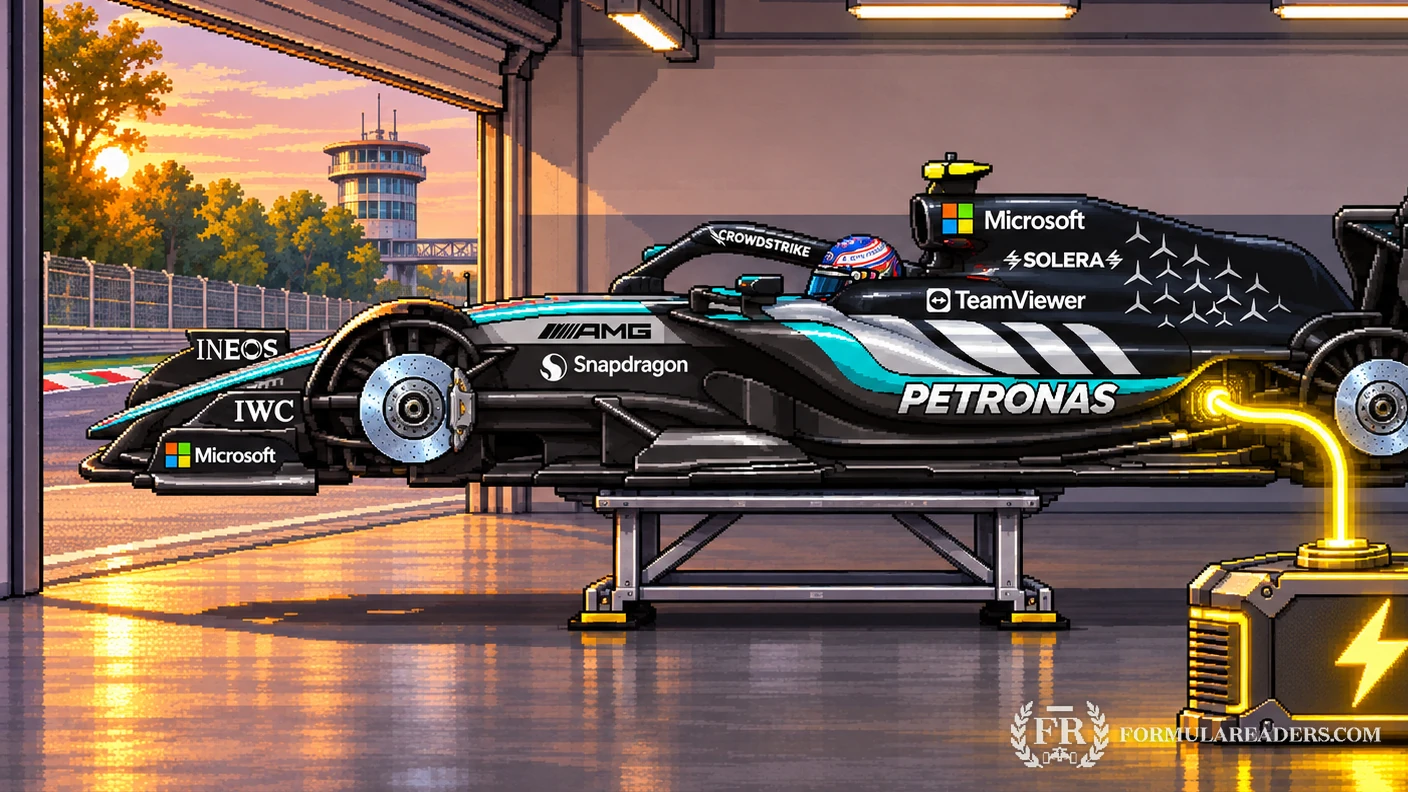
Mercedes and McLaren debut ADUO turbo in Las Vegas
Mercedes introduces a new turbocharger in Kimi Antonelli's car to validate development, while George Russell does not use it to avoid a grid penalty. McLaren will fit the same part in both cars, but Oscar Piastri will receive a ten-place penalty for installing a fifth thermal engine. Toto Wolff and the British team confirm that the performance benefit is modest and prioritise championship strategy.
 Mercedes announce Kimi Antonelli F1 engine upgrade but George Russell won't be getting it
 Antonelli and Piastri, with grid penalties in Las Vegas for power unit changes
 Mercedes unveils new turbo in Las Vegas; Piastri starts with penalty
 Why Russell won't run Mercedes' upgraded turbocharger in Vegas
 McLaren to use new turbo in Las Vegas; Piastri to start penalised on the grid
 Mercedes makes upgrade decision as Antonelli receives ADUO update
- McLaren to use new turbo in Las Vegas; Piastri to face engine penalty
 McLaren announces engine change for Piastri and penalty at the Las Vegas Grand Prix
 McLaren will change Piastri's engine in Las Vegas and receive a 10-place penalty
 Mercedes to debut ADUO engine with Antonelli in Las Vegas
 Mercedes introduces a new turbo in Las Vegas solely for Antonelli
- Mercedes to use a new turbo for Antonelli only in Las Vegas
- Mercedes to use new turbo only in Antonelli's car in Las Vegas
- Toto Wolff explains why George Russell won't get Mercedes’ new turbo in Las Vegas
- Mercedes prepares new engine for Antonelli only in Las Vegas; Ferrari warns over tyre temperatures
- Mercedes will debut its ADUO upgrade in Las Vegas exclusively for Antonelli
- Mercedes' ADUO upgrade finally arrives, but Russell is left out
- Mercedes to debut new turbo with ADUO on Antonelli's car only in Las Vegas
- Mercedes will use its ADUO evolution in Las Vegas only with Kimi Antonelli
- Mercedes debuts its new engine in Las Vegas, but Russell will not use it
- Mercedes set to run ADUO engine upgrade in Las Vegas with one driver
- Mercedes will use engine update only on Antonelli's car in Las Vegas
- Mercedes plan to debut ADUO upgrade on Antonelli's car only
- Mercedes to debut turbo with ADUO only on Antonelli's car in Las Vegas
- Why George Russell won’t get Mercedes F1 engine upgrade at Las Vegas GP
FIA moves towards the return of V8 engines for 2030
The FIA and manufacturers have reached an agreement in principle to introduce 2.1-litre V8 engines from 2030, seeking greater simplicity and sound. Although the FIA published and then deleted announcements on social media, the consensus points to a lighter and more efficient unit that will retain part of the current hybrid technology. The change aims to balance electric performance with the emotion of the combustion engine.
Brembo redefines braking with the new electric power
Brembo explains that the new MGU-K power reduces the load on hydraulic brakes, especially at circuits like Monza, and requires coordinating regenerative braking with the mechanics. The Italian supplier details how the braking system now manages energy rather than just reducing speed, a key change in Formula 1's new technical era.
Las Vegas cold challenges tyres and engines
The low temperatures at the Las Vegas circuit make it difficult to warm up the tyres and manage the battery, a challenge Honda and Ferrari flag as critical for their performance. Pirelli confirms the softer compounds for the race, while drivers such as Norris and Verstappen warn about tyre behaviour in extreme cold conditions.
- Liam Lawson wary of potential 'trouble' striking Las Vegas F1 grand prix
- Williams analyses the technical challenges of Las Vegas: energy, cold and tyres
- Ready for Las Vegas Bullevard 😉 #F1 #RedBullRacing #LasVegasGP @Oracle
- One of F1's most UNIQUE Tracks | Oracle Virtual Laps
- How Red Bull holds vital advantage over rivals at F1's toughest test
- How F1 drivers and strategists tackle the Las Vegas Grand Prix
- Frigid Las Vegas to present F1 drivers with most unique 2026 challenge
- Max Verstappen raises 'different behaviours' warning ahead of unique F1 challenge
- What tyres will the teams have for the Las Vegas Grand Prix?
- The big challenge for the tyres at the F1 Las Vegas Grand Prix
- Honda fears the worst in Las Vegas over reliability issues
- Ferrari faces difficulties in Las Vegas due to power and aerodynamic limitations
- F1 drivers call for improvements to wet-weather tyres for low-downforce circuits
- Honda warns that the straights at Las Vegas will put a lot of strain on its power unit
- Pirelli picks the three softest compounds for the Las Vegas Grand Prix
 Alpine and Colapinto face the challenge of warming up tyres in Las Vegas
- Low temperatures and tyre management, key in the 2026 F1 Las Vegas Grand Prix
- Cold in Las Vegas: impact on tyres and batteries of the single-seaters
- Honda warns about the cold in Las Vegas and ERS reliability for Aston Martin
- Norris fears ‘scary times’ in Las Vegas as rain threatens sessions
- Ferrari warns about tyre temperatures at the Las Vegas Grand Prix
- Honda warns of the cold in Las Vegas and prioritises the reliability of its engine
Allison explains why Antonelli beat Russell in 2026
James Allison detailed that the new 2026 regulations favour corner entry, an advantage Antonelli exploits over Russell, who was superior in corner exit with the 2025 cars. This shift in handling balance also explains Lewis Hamilton's improved performance, who adapts better to braking management and confidence in the car.
- Allison explains why Antonelli's style outperformed Russell's in 2026
- Mercedes explains how Antonelli outpaced Russell due to changes in the technical regulations
- Mercedes explains Antonelli's advantage over Russell in 2026
- Allison: Antonelli beats Russell into the corner, key to Hamilton's resurgence
- Mercedes’ technical director explains how Antonelli leapt ahead of Russell in 2026 | Formula 1
Horner reveals how Red Bull adapted the RB18 to Verstappen
Christian Horner explained that the 2022 RB18 was designed for a classic driving style, but pressure from Verstappen's environment forced a technical change that disadvantaged Sergio Pérez. The original car had a predictable front axle, but it was modified to prioritise Verstappen as the team's most important asset.
Honda and Williams halt development for 2027
Honda is developing a new cylinder head for its 2027 engine and aims to close the gap with Mercedes and Red Bull, while prioritising reliability in the final races. Williams has decided not to bring new aerodynamic solutions to the track to reduce costs and focus on the development of the next model, despite their current lack of competitiveness.
- Williams rules out updates for 2027 and prioritises resource savings
- Alpine halts development of its A526 to focus on the 2027 car
- Honda develops new cylinder head for its 2027 engine and aims to close the gap with Mercedes and Red Bull
- What Sainz is most concerned about regarding Williams' car for 2027
- Honda prepares new cylinder head to improve combustion in 2027
Previous story: Mercedes debuts ADUO turbo exclusively for Antonelli; FIA targets V8 return in 2030 and Honda prepares new cylinder head